Trip Hazards and Uneven Concrete: What to Fix First
A raised or sunken slab edge is a safety problem first and a cosmetic one second, and it rarely fixes itself.
October 7, 2026 · 4 min read
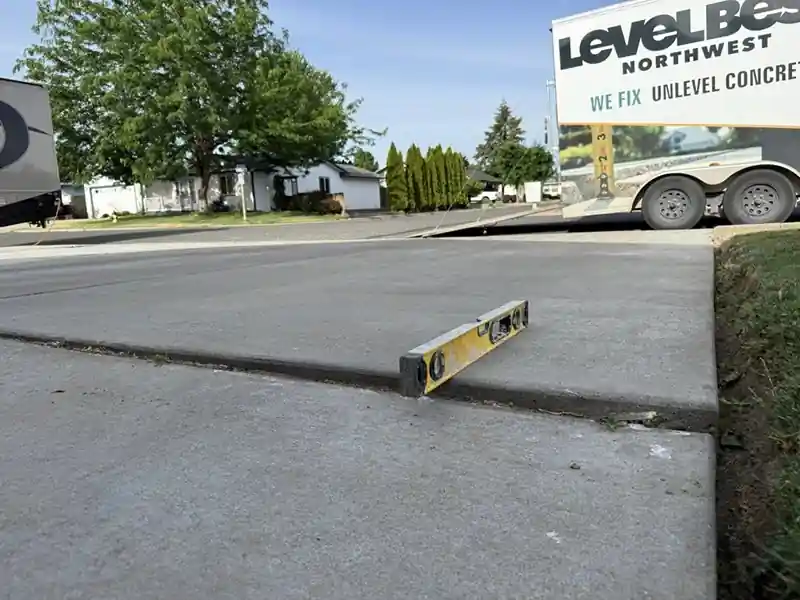
An uneven slab edge is a trip hazard, and it tends to grow. A height difference of about a quarter inch between neighboring panels is generally treated as one, and the soil movement behind it doesn't stop on its own. Lifting the low panel with polyurethane foam usually removes the hazard in a few hours, without tearing the walkway out.
Where we see them most
Concrete moves at its joints, so that's where lips form. A few places come up again and again:
- Sidewalk panels along tree-lined streets, where roots push some panels up and erosion drops others.
- Driveway joints and aprons, especially near irrigation.
- Entry steps and the slab at a door, where a gap can open up between the slab and the threshold.
- Garage floors and the step where the floor meets the apron.
- Business entrances and loading areas, where foot traffic, snowmelt and old drainage wear at the base.
Signs your driveway is heading that way
Walkways are easy to judge because you trip on them. Driveways give quieter warnings:
- Cracks that keep getting wider.
- Puddles that sit after rain instead of draining off.
- One section sitting lower than the next.
- Sharp edges where panels meet.
- A car that scrapes going in or out.
Any one of these means the ground under the slab is changing. The earlier you catch it, the smaller and cheaper the lift tends to be.
Why this matters beyond the stumble
If you own rental property, manage a building, run a shop, or maintain a shared walkway, a trip hazard is a responsibility as well as an annoyance. Tenants, customers and delivery people all use those surfaces, and a lip that catches a toe can hurt someone. Property owners can be held responsible when a known hazard goes unfixed, so it's worth talking with your insurance agent or an attorney about your own situation. We're a concrete crew, not lawyers, but we can tell you that repairs done early are far less trouble than dealing with an injury.
Landlords have an extra reason to pay attention. Rental concrete gets heavier use and often less regular upkeep than an owner-occupied home, and small problems get missed between tenants. Settled walkways, cracked driveways, garage floors that have dropped and worn patios are the usual list. Because most of our work is finished in one day with little disruption, repairs can fit around tenant turnover or be scheduled with the people living there.
Uneven concrete also affects access. Walkers, wheelchair and stroller users, and anyone carrying something heavy feel a raised edge much more than the rest of us do. For a business, an even entrance is part of the first impression.
How foam lifting fixes it
We raise the low panel back to meet its neighbor. The steps are simple:
- Measure the drop, so we know how far the panel needs to travel.
- Drill small holes, about 5/8 of an inch, through the sunken slab.
- Inject Eco-Rise polyurethane foam, which fills the voids under the slab and lifts it.
- Patch the holes. The foam cures in about 15 minutes.
On a sidewalk in Ellensburg, a settled joint had left a raised lip. Before lifting anything, Merle set a dial indicator across the joint to read the exact drop, because overshooting is how you crack a slab. We then brought the panel up until a level laid across the joint sat flat. No demolition, no new pour, and people were walking on it that afternoon.
Lifting beats grinding for most settled panels
Another way to hide a lip is to grind the high edge down, which can leave a rough, thinner section and doesn't fix the sunken support underneath. Lifting puts the low panel back where it belongs and fills the void that caused the drop. If a slab has simply settled, it's usually the cleaner answer. We'll tell you if yours is a better candidate for something else.
When lifting isn't the answer
If the panel has broken into loose pieces or is crumbling all the way through, lifting it won't produce a sound walkway. In that case replacing that section is the honest recommendation, and we'll say so. A slab that has only dropped is a good candidate for leveling. A slab that has failed as concrete is not.
Uneven concrete won't correct itself, and winter makes it worse. Water gets into the gaps, freezes, and widens them. Fixing a trip hazard before the cold weather arrives is cheaper than fixing it after, and much cheaper than after someone gets hurt.
Call Level Best Northwest at (509) 796-0658 for a free estimate on sidewalks, driveways, entries and garage floors. We work with homeowners, landlords and business owners across the Yakima Valley, the Tri-Cities and Ellensburg.
Level Best Northwest, (509) 796-0658
Call (509) 796-0658More articles
Concrete Leveling vs Replacement: Which Does Your Sunken Slab Need?
Most sunken concrete is still good concrete sitting on bad soil, and that changes the repair completely.
Foam Lifting vs Mudjacking: What's the Difference?
Both methods lift sunken concrete, but they differ in weight, hole size, cure time and how well the repair holds up.