Concrete Leveling vs Replacement: Which Does Your Sunken Slab Need?
Most sunken concrete is still good concrete sitting on bad soil, and that changes the repair completely.
October 7, 2026 · 4 min read
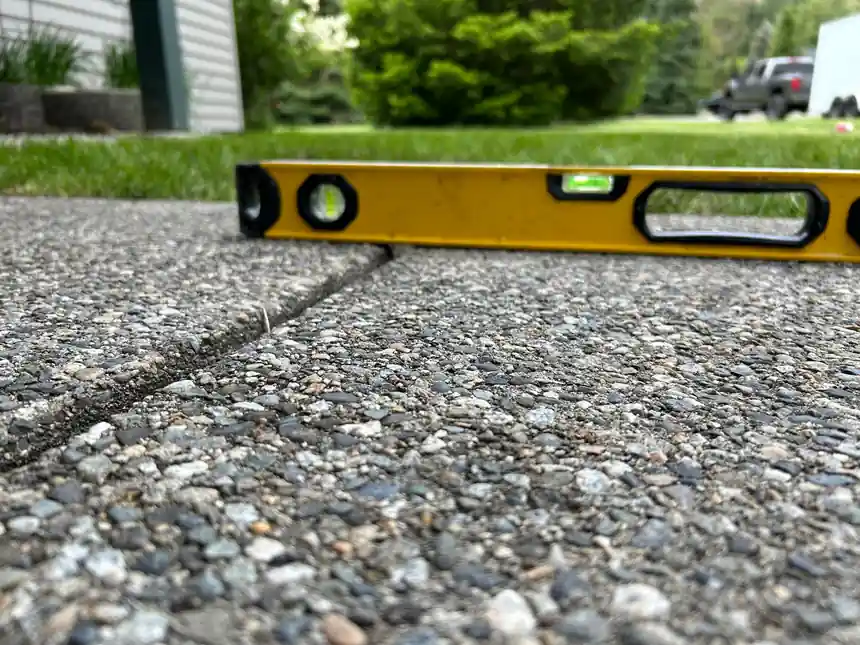
If your slab has sunk but is still in one solid piece, you probably don't need to replace it. Leveling lifts the concrete you already have back to grade, usually in a single day, and it's generally about half the cost of tearing out and pouring new. Replacement is the right call only when the concrete itself has failed, not when it has simply dropped.
That one distinction, failed concrete versus failed soil, decides almost every job we look at across the Yakima Valley. Here's how to tell which one you've got.
The problem is usually the ground, not the slab
When a driveway tilts or a sidewalk panel drops, it's natural to blame the concrete. Most of the time the concrete is fine. What changed is the support under it. Water washes fine soil out from beneath a slab. Loose fill that was never compacted well settles a little more each year. Winter freezing and thawing loosens the ground. Over time a void opens up, and the slab follows it down.
That matters for the replacement decision. If you pour a new slab onto the same weak ground, you've fixed the surface and left the cause alone. The new concrete can settle the same way, and you've paid for the same problem twice.
What leveling involves
We use Eco-Rise polyurethane foam, a two-part, closed-cell foam made for lifting concrete and filling voids. The work follows three steps:
- Drill: we cut small holes, about 5/8 of an inch, through the sunken slab.
- Pump: the foam goes in under the slab, expands, fills the voids and gently lifts the concrete back to a stable level.
- Patch: the foam cures in about 15 minutes, and we patch the holes so they're hard to find.
Most jobs are done in one day. There's no demolition, no hauled-away rubble, and your lawn and landscaping stay where they are. We use the same method on sidewalks and walkways, driveways, garage floors, patios and pool decks, entry steps, and slabs in basements and crawl spaces.
What replacement involves
Replacement means breaking out the old slab, hauling the pieces away, preparing the base, pouring new concrete, and then waiting for it to cure. That can take days before you can use it fully, and it brings noise, dust and equipment onto your property. There are also disposal costs and, often, repair work to the landscaping around the slab.
Replacement has its place. If you've got ground that's badly unstable, replacement paired with soil work may be the only lasting answer. But for the everyday sunken driveway or sidewalk, it's a lot of money and mess to spend on concrete that was still doing its job.
When replacement is the honest answer
We'd rather tell you the truth than lift something that can't be saved. Leveling won't give you a sound surface if the slab has:
- Broken into several loose pieces
- Crumbled or deteriorated all the way through, not just on the surface
- Reached the end of its useful life after decades of wear
Worn or flaking surface on otherwise solid concrete is a different case. That's usually a job for resurfacing or crack repair, not a teardown. And to be clear about what we do: we repair concrete, we don't perform structural foundation repair. If what you're seeing points to something structural, we'll say so and send you in the right direction.
A quick way to sort out your own slab
- One solid piece that has dropped or tilted: a strong candidate for leveling.
- Hollow sound when you walk across it or bounce a ball on it: there's likely a void underneath, which foam fills.
- A visible gap between the slab and the ground when you look from the side: the support is missing, not the concrete.
- Surface that's worn, pitted or flaking but still level: resurfacing is the better fit.
- Cracked into loose chunks or crumbling through: replacement is probably coming.
Cost follows the size of the area and how far it dropped, so we won't guess at a number from a description. What we can say from our own work is that leveling is generally about half the cost of replacing, and it skips the demolition, the disposal and the waiting.
Get a second look before you tear anything out
If someone has already told you the slab has to come out, it's worth having us look first. We come out, check how the slab has settled, and tell you plainly whether it's a lift, a repair, or a replacement. Level Best Northwest is a father-and-son company based in Zillah, and we've spent more than 10 years doing this work in the Yakima Valley, Tri-Cities and Ellensburg.
Call us at (509) 796-0658 for a free estimate. We'd be glad to tell you what your concrete actually needs, even if the answer is that it needs less than you were told.
Level Best Northwest, (509) 796-0658
Call (509) 796-0658More articles
Foam Lifting vs Mudjacking: What's the Difference?
Both methods lift sunken concrete, but they differ in weight, hole size, cure time and how well the repair holds up.
Why Concrete Sinks in the Yakima Valley (and How to Slow It Down)
Concrete sinks when the ground under it moves or washes away, and in Central Washington water is usually the reason.